
There’s a lot of modalities and therapeutic approaches on offer out there. Therapy, EMDR, IFS, hypnotherapy, NLP, tapping in its various forms, and the method I built, Head Trash Clearance. Each has its own training world, its own language, and its own believers, which makes choosing between them harder than it should be.
So to help with this, I thought I’d create a map instead. A map doesn’t tell you where to go; it shows you where everything is, so you can pick the destination that fits your situation. And each position on these maps is argued for, honestly and in detail, in a full comparison post, where you’ll find HTC conceding rows to every method here: evidence to EMDR and therapy, the relational container to IFS, habit-speed to hypnotherapy. If you catch a position you disagree with, the individual post is where the reasoning lives, and I’d genuinely like to hear the disagreement.
One idea unlocks all three maps, so let’s start there.
The layers
Your inner world operates in layers.
At the top sits the conscious mind: the thoughts you’re aware of having, the story you can tell about yourself. Just beneath it sits mindset, where you’re being deliberate about your thinking, choosing the frame, adopting the attitude. Mindset work is real work, but notice that it’s still conscious: you’re steering.
Below that sit your patterns: the default settings that fire on their own. The snap of anger, the wave of dread before the meeting, the same relationship playing out with a new face. Nobody chooses these in the moment; they run automatically, which is why no amount of deliberate thinking reliably overrides them. You can be as intentional as you like at the mindset layer and still watch yourself do the thing.
And beneath the patterns sits what powers them: the emotional charge. Patterns aren’t random habits; they’re held in place by charge, the emotional load a theme carries in your system. While the charge is live, the system keeps rebuilding the pattern, however many times you re-frame it, re-code it, or understand it. When the charge is cleared, the pattern has nothing keeping it alive.
Every method on these maps is working somewhere on that stack. None of them is lying about getting results, because there are real results available at every layer. The question a map can answer is: which layer, and at what cost in time, disclosure and dependence?
Map 1: The layer it works at, and who does the work
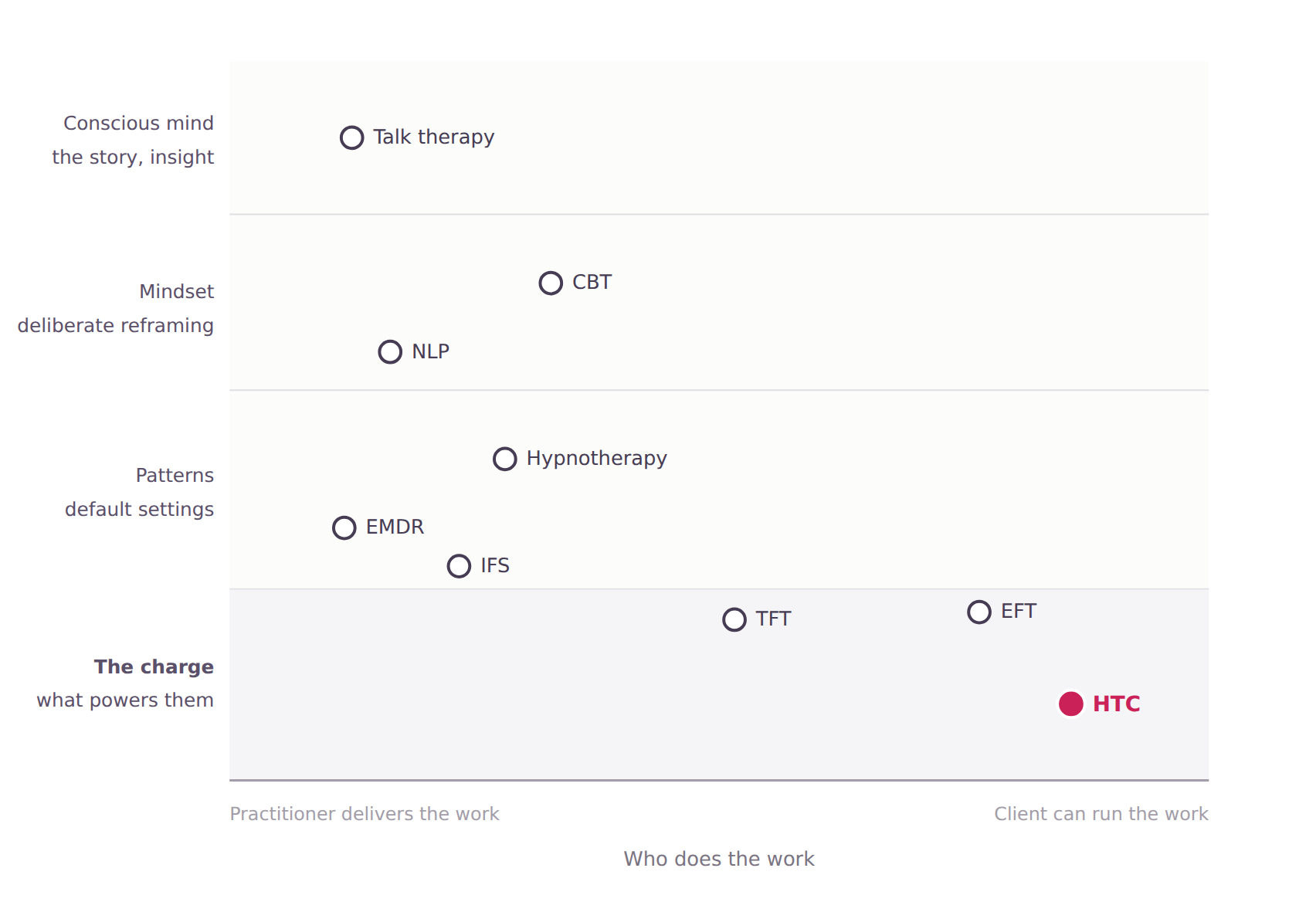
Two things about this map. The vertical axis is the stack you’ve just read: methods higher up work with the story and the deliberate mind; methods lower down work beneath awareness. The horizontal axis is about hands: on the left, the practitioner delivers the work in the session; on the right, the client can do the work themselves.
The pattern that jumps out is the empty corner. The deep-and-self-led corner is almost unoccupied, and there’s a reason: most deep methods reach depth through the practitioner. EMDR needs the practitioner to run reprocessing. IFS reaches the deep material through guided relationship. The tapping family hands the client real tools, which is why EFT sits so far right, but works symptom by symptom rather than on the theme beneath.
HTC occupies that corner comfortably: it’s a method that works at the charge layer and is designed to be taught to the client. The full reasoning for its position, and everyone else’s, is in the individual posts.
Map 2: What the client has to bring
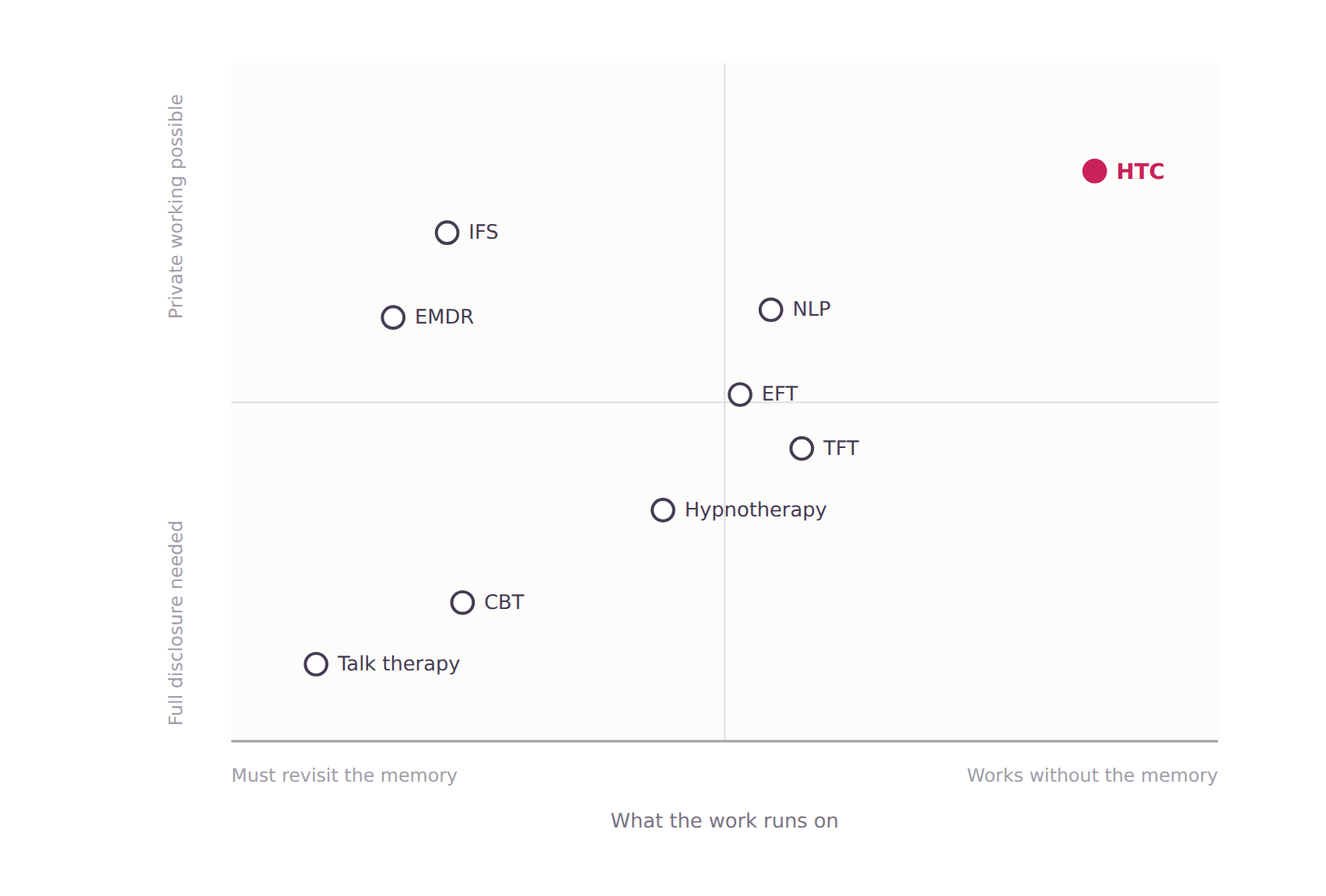
Two questions every prospective client quietly asks themselves: will I have to go back “there”, and will I have to tell you about it?
The horizontal axis is the first question. Talk therapy and EMDR run on the memory: the story is the material, or the memory must be activated for the mechanism to work. The right side works without revisiting: the charge, the pattern or the representation is worked on directly.
The vertical axis is the second question, and it holds some surprises. EMDR asks for less narration than people assume, and IFS lets a client witness privately without saying the detail aloud; both sit higher than their reputations suggest. The talking approaches can’t offer this, because talking is the medium. HTC sits in the top-right because it needs neither: it works with the charge rather than the memory, and where a client can’t or won’t disclose, the work can still be done.
For clients carrying shame-soaked material, this map is sometimes the whole decision.
Map 3: The practitioner’s road in, and up
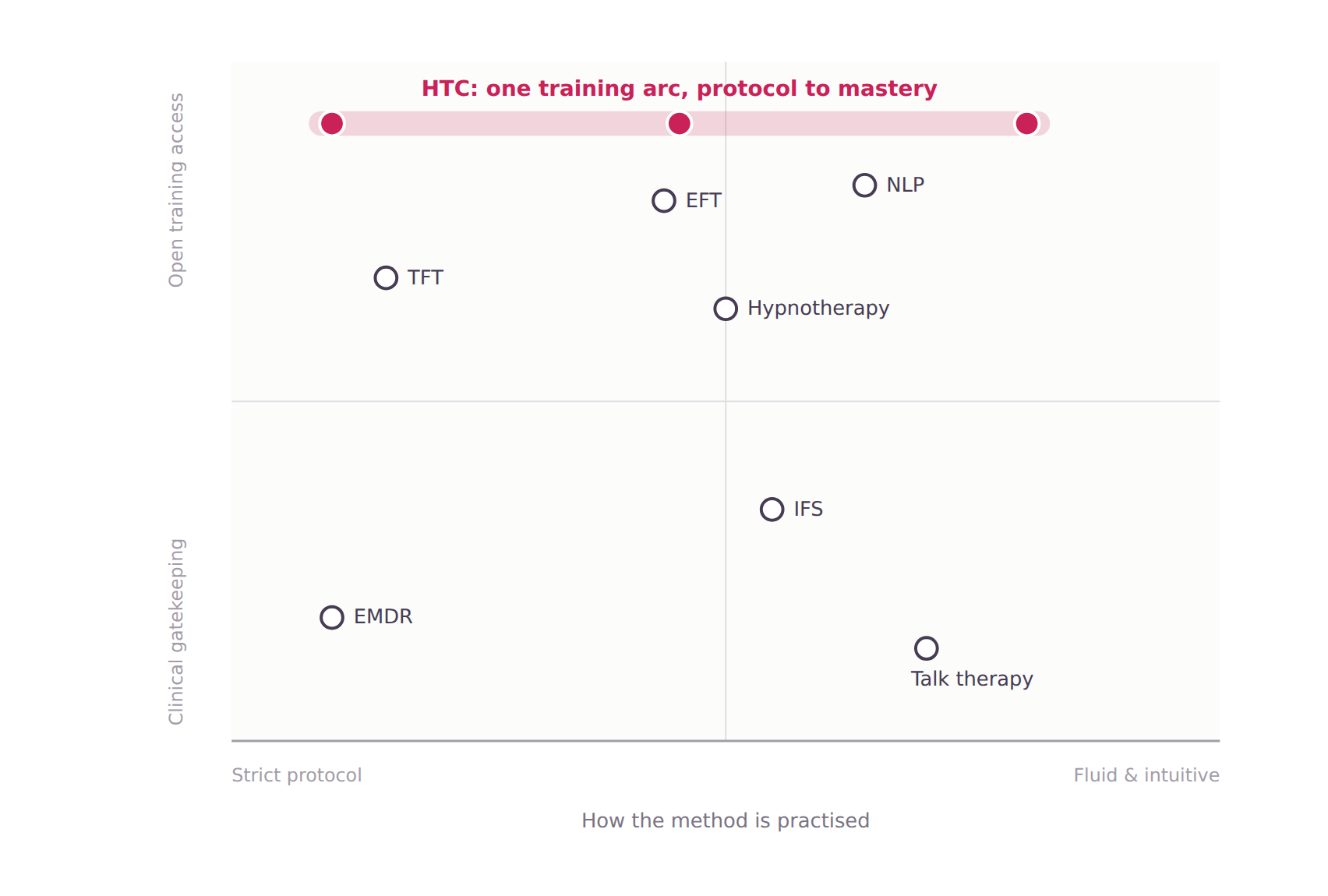
This one is for the coaches, therapists and practitioners deciding what to train in.
The horizontal axis runs from strict protocol to fluid, intuitive practice. Neither end is better: a strict protocol is a gift when you’re new, and fluidity is what mastery feels like. The vertical axis is access: how open the training door is. EMDR and talk therapy sit behind clinical gatekeeping; the tapping family, NLP and hypnotherapy are open; IFS is open in principle and oversubscribed in practice.
HTC is drawn as a band rather than a dot, and that’s the point of it. The training is designed to cover the span: a strict protocol at the floor while you’re new, a framework as you find your feet, and fluid, intuitive work at mastery, all inside one open arc rather than behind a sequence of gated levels. Hypnotherapy and EFT stretch along this axis too, as the caption notes; drawing everyone’s full range would turn the map into soup, so the dots mark centres of gravity and the posts carry the nuance.
How to use the maps
If you’re choosing for yourself: start with Map 2, because it tells you what the work will ask of you, then Map 1, because it tells you what layer your problem probably lives at. A contained habit may not need the charge layer. A theme that has survived years of good work at the upper layers probably does.
If you’re a practitioner: Map 3 tells you what’s trainable and how the mastery arc runs, and Map 1 tells you what a method will add to what you already have. The strongest combinations pair tools from different layers, which is why so many practitioners stack rather than switch.
And whichever you are, the individual comparisons carry the detail, the conceded rows included:
- HTC vs Therapy
- HTC vs EMDR
- HTC vs IFS (coming soon)
- HTC vs Hypnotherapy (coming soon)
- HTC vs NLP
- HTC vs EFT (coming soon)
- HTC vs TFT
If the speed implied by the charge layer sounds implausible, that’s a reasonable reaction with its own page: That sounds too good to be true. And the honest state of the evidence, for HTC and everyone else, is here: Where the HTC evidence stands.
Curious about adding HTC to your toolkit? Explore HTC Practitioner Training.